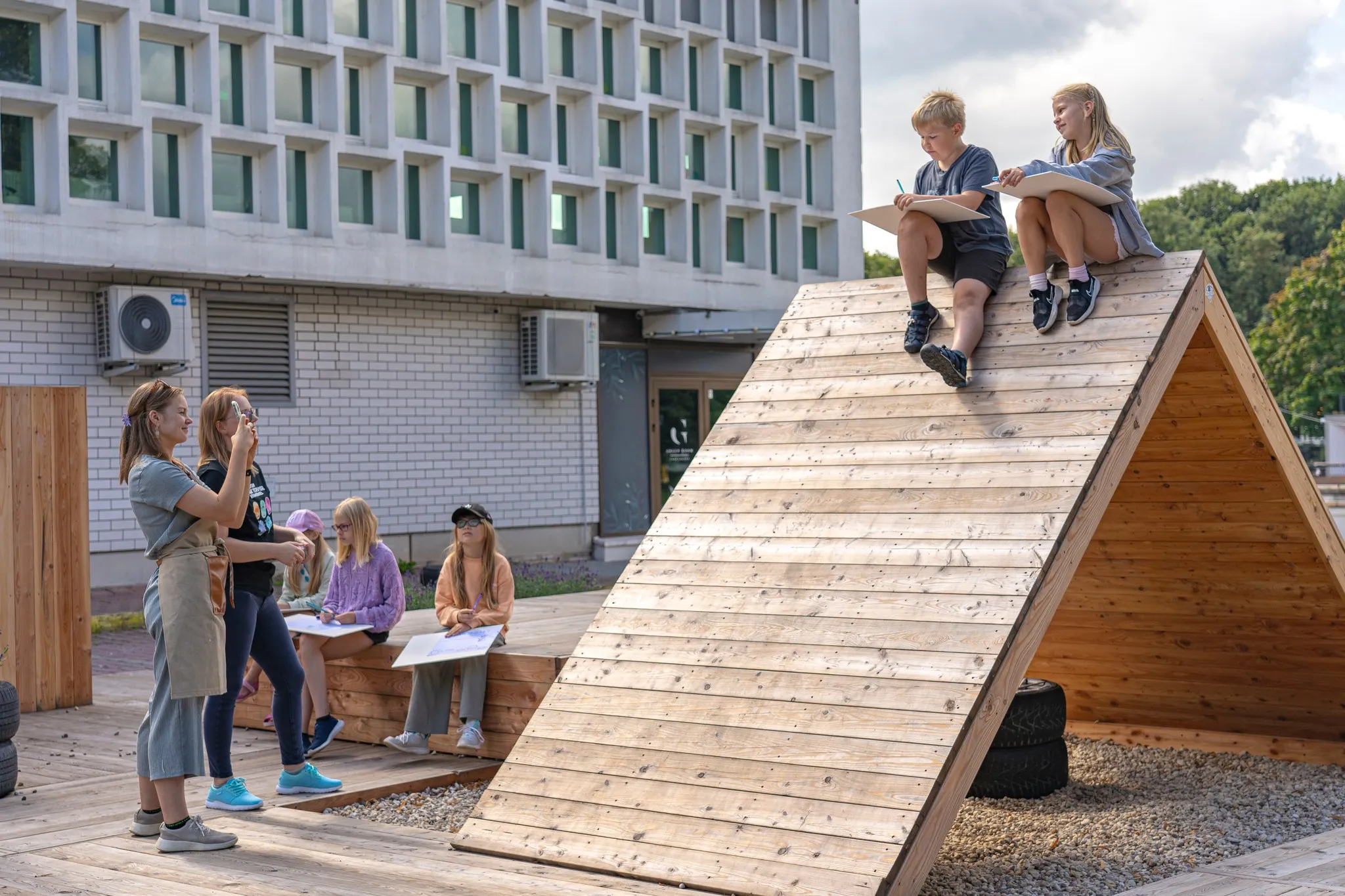
Summer is officially here, schoolbags have been tossed into the corner, and the most anticipated time of the year has begun — summer vacation! For the Future Blocks project team, this is an exceptionally exciting and meaningful period. Why? Because it is during the summer that children’s movement in public spaces becomes completely different, freer, and much more natural.
While during the school year children’s trajectories are often strictly mapped out (home-school-hobby class, usually safely in the backseat of a car), in the summer they break free from this routine. They are out on the streets, in parks, around libraries, and on playgrounds. They switch environments faster than ever before: one day adventuring in the countryside at their grandparents’ or friends’ place surrounded by nature, the next day cruising on city asphalt or a small-town central square on a scooter.
This dynamic summer gives all of us — parents, urban planners, and communities — an excellent opportunity to look at our surroundings through a child’s eyes. Is our public space actually child-friendly?
The summer shift between environments highlights the pros and cons of our public spaces in sharp contrast:
A child-friendly space does not just mean a colorful playground surrounded by a fence. It means an environment where a child can move safely and independently from point A to point B, feeling welcome and protected in every neighborhood and country lane.
There is a golden rule in urban planning: design an environment for children, and you create the best possible space for absolutely everyone. A street that is safe and comfortable for an 8-year-old on a scooter is just as convenient for a parent pushing a stroller, an adult carrying groceries home, or an elderly grandfather walking with a cane. Children’s needs — safety, clarity, accessibility, and places to take a break — are the foundation of a human-centric living environment. By making a space good for children, we make it better for everyone.
We adults have a tendency to design the world from our own perspective. We think we know what children need. But in the Future Blocks project launched by Vivita (developed in partnership with the National Library of Estonia and the University of Groningen), we believe in something much greater: children’s participation in community development must become a core European democratic value.
Children notice details that an adult’s eye misses: a curb that is too high, making a scooter ride uncomfortable; a dark corner that feels scary; or a boring patch of grass that could easily be turned into the neighborhood’s best hangout spot. Our design sprints prove that when given total freedom and the right tools, children’s creativity and visionary ideas are truly next-level!
Involving children is not just about “ticking a box” — it is about modernizing our living environments together with those who actually live, move, and play there.
This summer, Future Blocks calls upon all adults, local municipalities, and communities to notice and engage in genuine dialogue with children. When you walk in the city or drive through the countryside, look around through a child’s eyes, or better yet — take a child by the hand and ask them:
Change begins with observation and co-creation. Let’s build stronger, safer, and more child-friendly neighborhoods — building the future, one block at a time!
Have a wonderful, free, and adventure-filled summer vacation!

Funded by the European Union. Views and opinions expressed are however those of the author(s) only and do not necessarily reflect those of the European Union or the European Education and Culture Executive Agency (EACEA). Neither the European Union nor the granting authority can be held responsible for them. Project number 101254173, Citizens, Equality, Rights and Values Programme (CERV).