How do you support children through a high-stakes regional transition? You give them a seat at the table and the tools to co-design the solutions.
When local structural reforms occur, children are often the last ones consulted - even though the outcomes directly shape their daily lives. Through the Future Blocks project, we aim to change that paradigm.
As an official associated partner in the project, Pöide School in Saaremaa is embarking on a multi-stage journey with us that includes a series of four dedicated co-creation design sprints. Together, these sessions provide students with a continuous platform for civic agency while testing and refining a scalable, open-source child participation toolkit that municipalities across Europe can adopt in the future.
For our first design sprint with Pöide School, the team from Vivita Lahenduste Laboratoorium teamed up with our project partners from the National Library of Estonia (RaRa) and traveled to Saaremaa. The day brought together 35 students spanning ages 8 to 16 (grades 1 through 9) to tackle an urgent, real-world community challenge: the upcoming school merger between Pöide School and Orissaare Gümnaasium.
Major regional school mergers naturally bring stress, social anxiety, and fears around the potential erasure of local traditions and identities. Rather than leaving students to passively experience this transition, the sprint provided a safe, structured environment to turn complex emotional friction into constructive civic action.
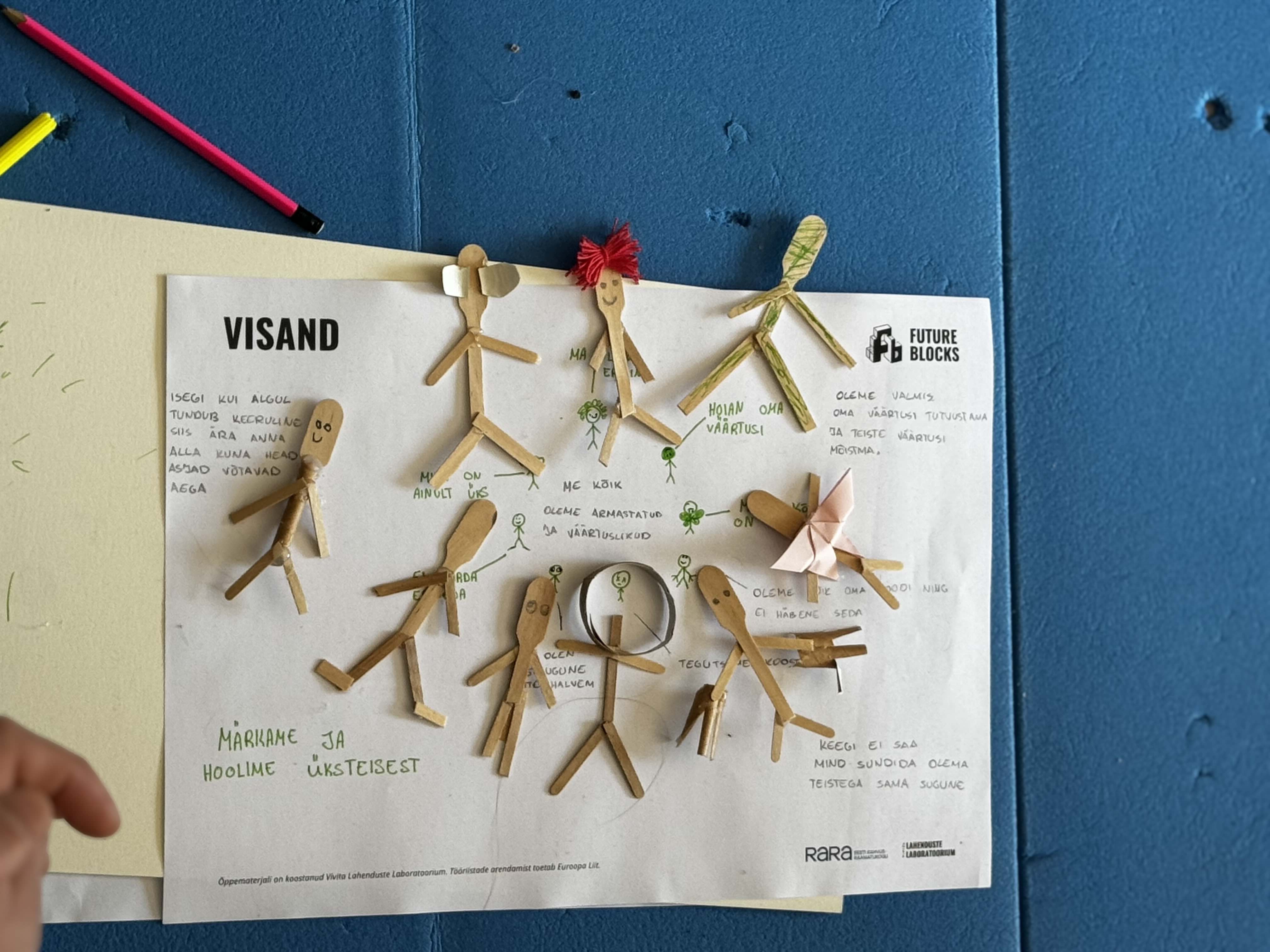
The day kicked off with a grounding, shared yoga warm-up led by the school's physical education teacher alongside adult mentors. Stepping into the dual professional roles of Scientists (exploring systemic problems) and Designers (creating solutions), the mixed-age teams mapped out their core concerns regarding the merger reform and moved rapidly into ideation and physical prototyping.
By shifting from designing for children to co-creating with them, the students developed deeply empathetic, practical concepts focused on safety, peer connection, and preserving community identity:
Beyond the inspiring prototypes, the session yielded crucial learnings on how to facilitate youth participation during times of community challenges. Small-school dynamics, non-hierarchical mentorship, and non-judgmental ideation spaces proved essential for helping children process complex systemic stress.
The success of this sprint reinforces the core vision of Future Blocks: when children are trusted with authentic agency, they don't just ask for superficial changes - they build compassionate, highly functional, and resilient community solutions.
We look forward to returning to Saaremaa for our upcoming sprints with Pöide School as we continue testing and building our municipal participation framework!
🇪🇺 Funded by the European Union. (The views and opinions expressed are those of the author(s) only and do not necessarily reflect those of the European Union.)
Funded by the European Union. Views and opinions expressed are however those of the author(s) only and do not necessarily reflect those of the European Union or the European Education and Culture Executive Agency (EACEA). Neither the European Union nor the granting authority can be held responsible for them. Project number 101254173, Citizens, Equality, Rights and Values Programme (CERV).